



What Is ISTQB?
ISTQB (International Software Testing Qualifications Board) is a globally recognized organization that sets standards for software testing education and certification. ISTQB is a not-for-profit organization based in Belgium, offering 25+ international certifications for software testing and QA professionals. It provides structured learning paths that help individuals develop the knowledge and skills needed to test software, identify defects, and improve software quality. ISTQB provides a range of Certified Tester qualifications, from foundational courses to advanced and specialized certifications, enabling professionals at different career stages to validate their testing expertise and pursue new opportunities in the IT sector.
Why Is ISTQB Certification Important?
- Career Advancement: Improves your professional profile and expands opportunities in software testing and quality assurance.
- Global Recognition: Validates your software testing knowledge worldwide.
- Comprehensive Learning: Develops practical knowledge of software testing methods and quality management principles.
- Career Growth: Supports advancement in testing, automation, and test management.
ISTQB Certification Levels Explained
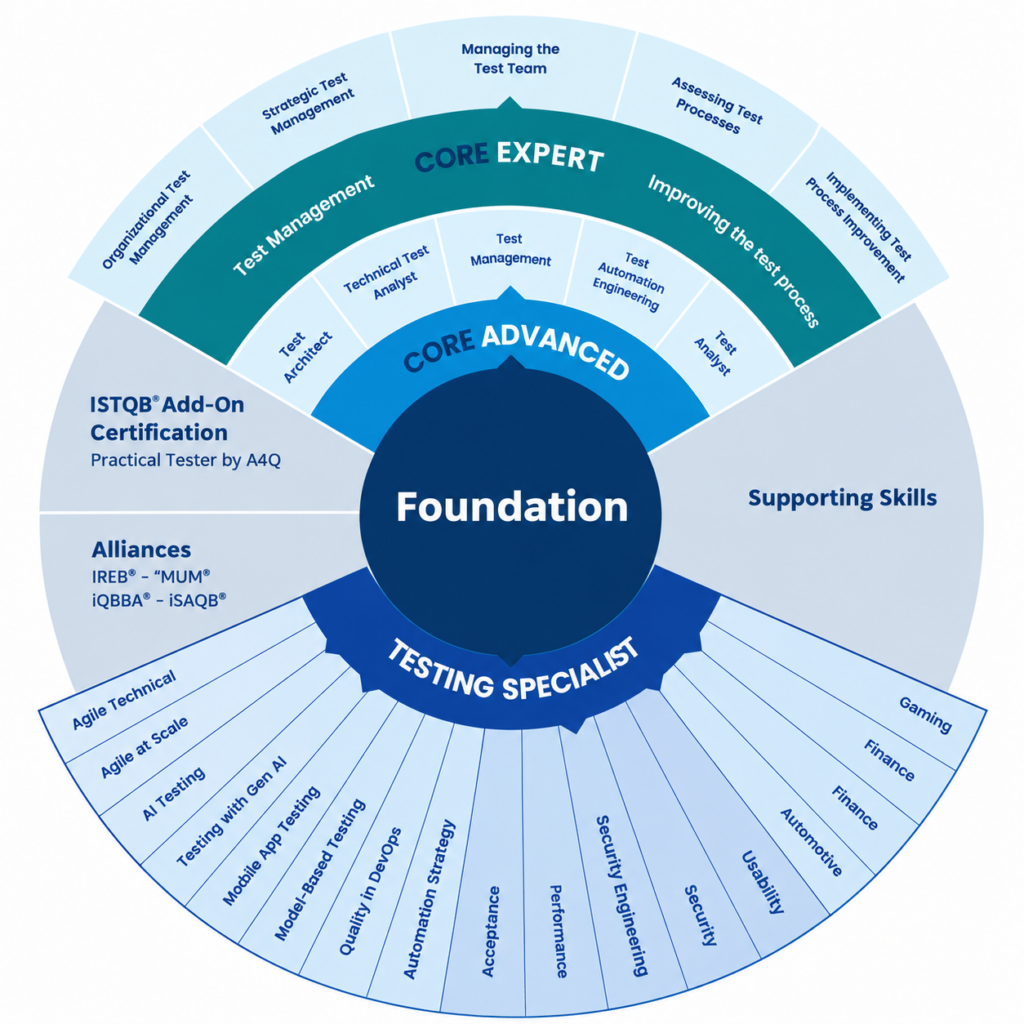
ISTQB Certifications are organized into four levels: Foundation, Advanced, Specialist and Expert. Here is how each one works.
What is ISTQB Foundation Level (CTFL) ?
The Certified Tester Foundation Level (CTFL) is the starting point and the most popular ISTQB course. The current syllabus is CTFL v4.0.
It covers:
- Fundamentals of Testing: Explains what testing is and why it matters, the seven testing principles, the test process and the roles and skills of a tester.
- Testing Throughout the Software Development Lifecycle: Shows how testing fits into models such as agile and DevOps, and covers the test levels (component, integration, system and acceptance) and test types.
- Static Testing and Test Techniques: Teaches reviews and static analysis to find defects without running code, plus black-box, white-box and experience-based techniques for designing test cases.
- Test Management: Covers test planning, estimation, risk, monitoring, and defect management.
- Test Tools: Introduces the tools that support testing, such as test management, automation and defect-tracking tools, and the benefits and risks of using them.
What is ISTQB Advanced Level Course?
The ISTQB Advanced Level is for testers who already have the Foundation certificate and some hands-on experience. You choose a path that matches your role:
- Test Analyst (CTAL-TA): Focuses on test design, including black-box and experience-based techniques, requirements analysis and quality characteristics such as usability.
- Technical Test Analyst (CTAL-TTA): Focuses on advanced testing methods, code analysis, performance and security evaluation, and technical reviews.
- Test Automation Engineering (CTAL-TAE): Explores automation framework development, tool selection, test maintenance, and CI/CD integration.
- Test Management (CTAL-TM): Develops skills in test planning, resource estimation, progress tracking, risk assessment, defect management, and team leadership.
- Agile Tester (CTAL-AT): Builds skills for testing inside agile teams, from collaborative practices to test strategy across iterations.
What is ISTQB Specialist Level Course?
Specialist certifications let you build expertise in a particular technology, approach or industry. Popular options include:
Technologies and approaches
- AI Testing (CT-AI): Testing AI-based systems, including data quality, model evaluation and bias.
- Testing with Generative AI (CT-GenAI): Applying generative AI to test tasks responsibly.
- Mobile Application Testing (CT-MAT): Testing apps across devices, networks and platforms.
- Test Automation Strategy (CT-TAS): Planning and scaling automation across an organization.
- Quality in DevOps (CT-QDO): Integrating quality assurance practices throughout the DevOps lifecycle to enable reliable and efficient software delivery.
Quality characteristics and test levels
- Security Tester (CT-SEC): Learn to identify software security weaknesses and implement effective security testing methods to assess system protection.
- Performance Testing (CT-PT): Load, stress and performance measurement.
- Usability Testing (CT-UT): Assesses a product’s ease of use, accessibility, and overall user experience.
- Acceptance Testing (CT-AcT): Determines whether software meets business requirements and user expectations.
Industry-Specific Certifications
- Automotive Software Tester (CT-AuT): Focuses on automotive software, embedded systems, and functional safety testing.
- Game Testing (CT-GaMe): Testing the gameplay, performance and user experience of video games.
- Finance Testing (CT-FT): Covers financial application testing, emphasizing accuracy, security, and regulatory compliance.
- Gambling Industry Tester (CT-GT): Focuses on testing gaming and betting software for fairness, reliability, and compliance.
What is ISTQB Expert Level Course ?
The Expert Level is the top tier, focused on test management and test process improvement. It suits senior professionals with extensive experience who lead testing strategies across organizations.
What is the ISTQB Course Fees and Exam Costs?
The cost of an ISTQB certification exam varies depending on your location, certification level, and chosen exam provider. Generally, exam fees for Foundation and Advanced Level certifications range from $100 to $250, with the final price depending on the examination method and local pricing policies.
| Certification Level | Approx. Fee Range (USD) |
| Foundation Level (CTFL) | $100 – $150 |
| Specialist modules | $100 – $200 |
| Advanced Level modules | $150 – $250 |
Fees are indicative only. For the latest ISTQB exam fees, refer to your local ISTQB member board or authorized exam provider. Training fees are generally charged separately from the certification exam fee.
How to Get ISTQB Certified: Step-by-Step
Step 1: Choose the Right Level
New to testing? Start with Foundation (CTFL). Move to Advance after Foundation and some project experience, then add a specialist module.
Step 2: Download the Official Syllabus and Glossary
Get the latest syllabus, glossary and sample questions free from istqb.org, and use the syllabus as your study checklist.
Step 3: Join an Accredited Training Course
ISTQB-accredited training supports effective preparation, with 2–6 weeks for Foundation Level and longer for Advanced Level.
Step 4: Practice with Sample Papers
Solve sample papers and timed mocks. The exam includes 40 MCQs, with 60 minutes to complete and a 65% passing score.
Step 5: Book Your Exam
Register through an authorized ISTQB exam provider and select your preferred exam date and format.
Step 6: Earn Your Certification
Add your Certified Tester certificate to your resume and LinkedIn, then plan your next level.
ISTQB Career Paths: Where Each Level Can Take You
ISTQB certifications support career progression through advanced expertise and specialized testing skills.
• Foundation: QA engineer, software tester, junior test analyst.
• Advanced Level: Opens pathways to senior testing, test leadership, and management roles.
• Specialist Level: Builds expertise in security, performance, AI, mobile, and domain-specific testing.
• Expert: Head of QA, test strategist, test process improvement
Learn ISTQB with TM SQUARE
Choosing the right trainer can make the difference between memorizing answers and truly understanding testing. TM SQUARE, a software training institute in Bangalore, offers ISTQB certification training, including the ISTQB Foundation Level (CTFL v4.0). Learners can also access free tutorial videos with sample exam questions to get started.
Whether you are a fresher or an experienced tester planning your next step, TM SQUARE can help you prepare with confidence. Visit tmsquare.co or email info@tmsquare.co to learn about upcoming batches.
